“It is a famous hot-spring property, so it is probably a safe bet” — you book on that basis, and it turns out not to be what you expected. Most people have had that experience.
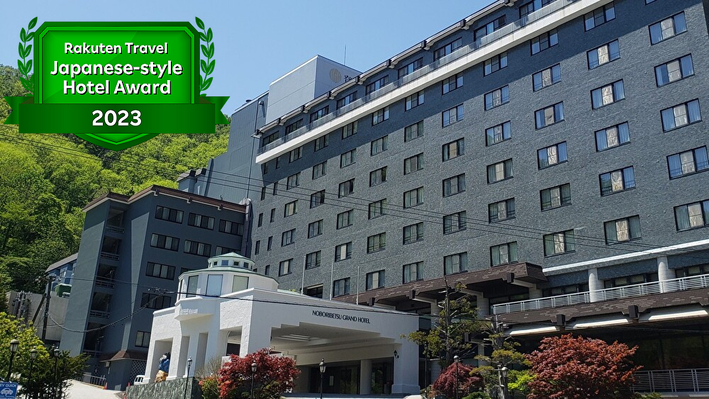
Noboribetsu Grand Hotel is one of Hokkaido’s most historic hot-spring properties, founded in 1938. It is a place of some standing: the official website records that Emperor Showa and the Empress stayed twice, and the Emperor Emeritus twice. In recent years it has also become known for its “Oni Sauna”, supervised by Dai Matsuo of TTNE, a well-known figure in Japan’s sauna world.
Having heard it was an upmarket property, the two of us went with high expectations. We even booked a suite at around 90,000 yen for the night.
To give the conclusion first: our satisfaction ended up honestly rather low. It is not that the facilities are poor. But asked whether we got an experience worth what we paid, we could not honestly nod.
This article sets out concretely what disappointed us. At the same time, we have worked out from the official information that it stems from a structural characteristic of this property. Read it and you should be able to judge whether it suits you.
* Rates, opening hours and services are subject to change. Please always check the official website for the latest information before booking.
What this article covers
- Our sense, having stayed in a suite, that it did not justify the difference in price
- Why we could not linger in the famous Oni Sauna or the communal bath (worked out from the official day-visitor admission times)
- What time to aim for if you want to avoid the crowds
- How much trouble we had finding somewhere to eat in the Noboribetsu Onsen area
- Our score of 2.5 out of 5, and the breakdown behind it
Noboribetsu Grand Hotel: the basics
| Item | Details (from the official website, as of July 2026) |
|---|---|
| Property name | Noboribetsu Grand Hotel |
| Address | 154 Noboribetsu Onsen-cho, Noboribetsu City, Hokkaido |
| Founded | 1938 |
| Hot spring | Three spring types, said to be the richest range in Hokkaido. A domed Roman-style communal bath, and garden open-air baths (hinoki and rock) |
| Saunas | Oni Sauna / Seiryu Sauna / Kuma Sauna. The Oni Sauna was created in September 2022 when the garden open-air bath was refurbished, supervised by Dai Matsuo of TTNE |
| Room types | Western / Japanese / South Wing Comfort Twin / executive floor / rooms with open-air bath / special rooms / state rooms |
| Family bath | Saline spring, free-flowing from the source. 50 minutes for 4,400 yen (incl. tax), up to 4 people, booking required |
| Day-visitor bathing | Available (see below) |
Getting there from the nearest station
* About 8 km north of JR Noboribetsu Station.
Open in Google MapsA property the Showa Emperor stayed at twice: the history
There is a reason the two of us had it in our heads that this was an upmarket property. Members of the Imperial Family have stayed here repeatedly, and the record is set out plainly in the company history on the official website.
| Year | Event |
|---|---|
| 1937 | Noboribetsu Grand Hotel Co., Ltd. incorporated |
| 1938 | Opening ceremony. Began trading with 70 rooms (56 Japanese, 14 Western) and capacity for 200 guests |
| 1945 | Requisitioned as accommodation for the US forces stationed in Hokkaido |
| 1952 | Requisition lifted; trading resumed |
| 1954 | Emperor Showa and the Empress stayed |
| 1958 | The Crown Prince (now Emperor Emeritus) stayed |
| 1961 | Emperor Showa and the Empress stayed again |
| 1981 | The main building was demolished — but the Roman-style circular bath and the women’s bath were kept |
| 2008 | During the G8 Hokkaido Toyako Summit, used as the residence of the United States Embassy |
| 2011 | The Emperor (now Emperor Emeritus) stayed |
| 2014 | The executive floor in the seventh-floor Western wing was refurbished |
| 2022 | The garden open-air bath was refurbished and the “Oni Sauna” added |
| 2023 | The communal bath saunas were rebuilt as the “Seiryu Sauna” and “Kuma Sauna”, and a “giant barrel cold bath” was added |
Four recorded Imperial stays. Emperor Showa and the Empress twice, and the Emperor Emeritus twice — once as Crown Prince and once while on the throne. On top of that, during the 2008 Hokkaido Toyako Summit it served as the residence of the United States Embassy.
The other thing worth noting is the demolition of the main building in 1981. When the building came down, the Roman-style circular bath alone was preserved. The domed Roman-style communal bath you can use today carries on the style of the property as it opened in 1938, according to the official website.
Book knowing that history and it is natural to expect a relaxed stay at a long-established property of some standing. Choosing a suite was an extension of that for us.
In the event, though, that way of setting expectations did not fit what this property now is. The reason lies in how the baths are run, which the next section explains.
The place itself: 10,000 tonnes a day, and “the department store of hot springs”
Before the property itself, a little about the Noboribetsu Onsen area, which makes the rest easier to follow.
Noboribetsu Onsen lies about 8 km north of JR Noboribetsu Station, at an altitude of around 200 m. Behind the hot-spring town, Jigokudani (“Hell Valley”), the largest source, sends up steam; the springs emerge at 45–90°C. Some 10,000 tonnes of hot-spring water rises naturally each day and is piped to the hotels and ryokan of the town.
What sets it apart is the number of different spring types that emerge here, which has earned it the nickname “the department store of hot springs”. Materials from Noboribetsu City and the local tourist association describe it as rare even globally, and note that scholars have come to study it since early times.
Its history is long. The explorer Takeshiro Matsuura visited in 1845. A road was cut for sulphur extraction in 1858, and Kinzo Takimoto became keeper of the springs — generally taken as the beginning of Noboribetsu Onsen. In 1905 it was designated a recuperation site for those wounded in the Russo-Japanese War, which made its name nationally.
In other words, Noboribetsu Onsen is fundamentally a place people come to for the water itself. Plenty of them come to bathe whether or not they are staying the night. That is the background to the problem we ran into.
Disappointment 1: the room was good, but a suite brought no special treatment at all
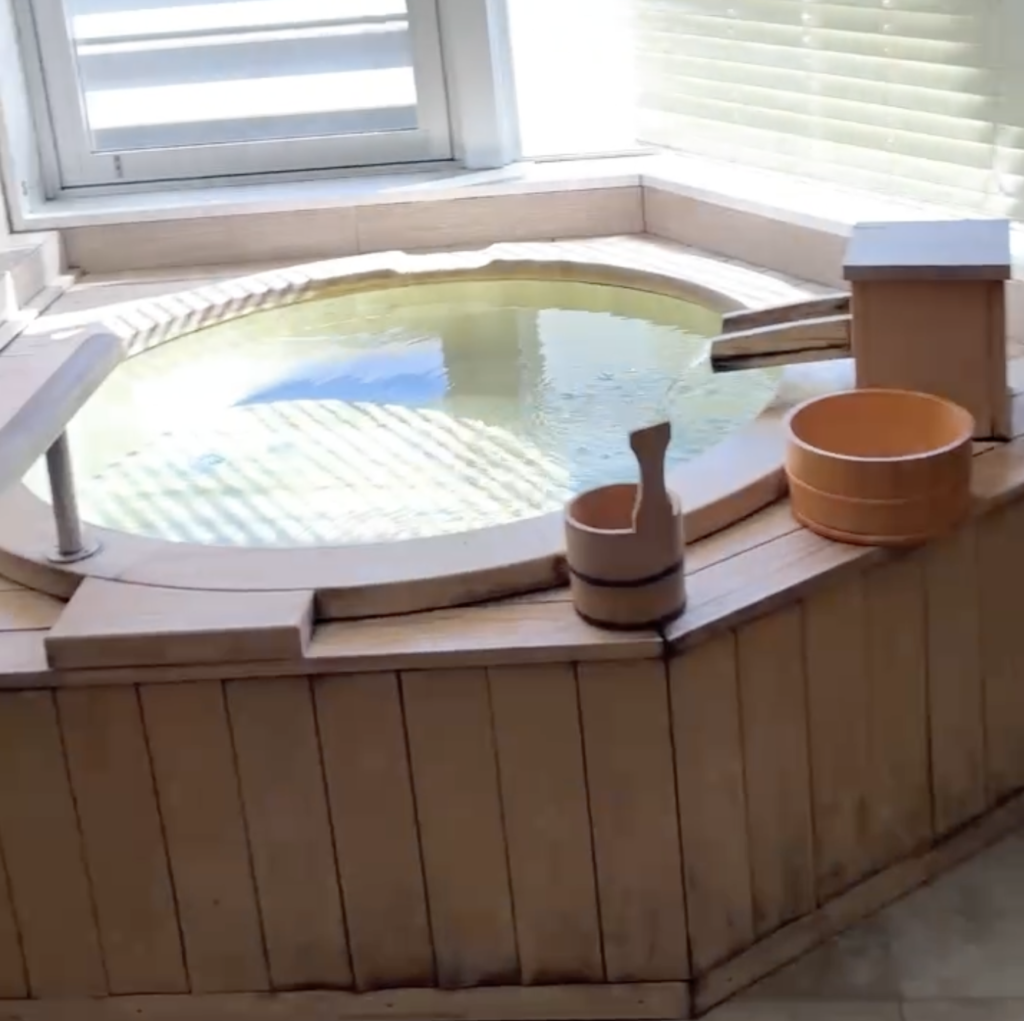
Since it was a special trip, we chose a suite with a view bath. The official website presents it as the executive floor, of which there are two rooms. The listed features include a lit dressing table, a walk-in wardrobe, two washbasins and a circular view bath.
As we recall, the rate was around 90,000 yen for the night (not an exact figure — a rough sense of it. It varies a great deal by season and plan). For two people, that works out at somewhere in the high 40,000s each.
To say it up front: the room itself was good. The in-room view bath in particular was satisfying, and we have no complaint there.
What snagged was not inside the room but outside it — the service was exactly the same as for any other stay.
With a suite or an executive floor at an upmarket hotel, you often get things beyond the room itself: use of a dedicated lounge, separate check-in and check-out, a welcome drink. That is what we had expected.
In practice, there was none of that. The grade of the room went up and nothing else about the stay differed from any other guest’s. Because the room was good, we were left thinking: “so we paid this much purely for the room?”
Disappointment 2: we could not linger in the famous Oni Sauna or the communal bath
Honestly, the main reason we chose this property was the Oni Sauna. A serious sauna supervised by a leading figure in the sauna world, at a historic hot-spring property. It is impossible not to look forward to that.
First, the facilities themselves are unquestionably the real thing
To avoid any misunderstanding: the baths and saunas here really are good as facilities. Setting out the official information shows how complete they are.
| Facility | Details (from the official website) |
|---|---|
| Communal bath | An airy domed Roman-style bath. Three spring types: saline, iron and sulphur. Supplied by continuous source injection with filtered circulation (water added and heated) |
| Garden open-air bath | Hinoki and rock baths with a view of a waterfall |
| Oni Sauna | Supervised by Dai Matsuo of TTNE. 110°C, automatic löyly (once every hour on the half hour), seats 14. The exterior is styled like the cliff faces of Jigokudani |
| Seiryu Sauna | 80°C, self-löyly. Uses stream water from Asahizawa, sourced in the foothills of north-eastern Noboribetsu. Allows self-whisking with Hokkaido-grown vihta — rare in Japan |
| Kuma Sauna | A sauna inside the indoor communal bath (rebuilt in 2023) |
| Giant barrel cold bath | 170 cm in height and diameter. Stream water at 16°C, among the deepest in Hokkaido. Seasonal, April to November; not available to under-13s |
| Hinoki cold bath | A hinoki cold bath, rare in Hokkaido. Stream water at 16°C |
| Hagama baths | Two rice-cauldron baths in the colours of the blue and red demons. Blue is the cold bath, red is 43–44°C, for alternating hot and cold |
Three saunas and three cold baths. The Oni Sauna runs at 110°C with automatic löyly; the Seiryu Sauna even lets you whisk with vihta. Of course a sauna lover gets their hopes up.
Note that as of July 2026 the official website carries a notice that the barrel cold bath is out of use for a while due to a fault. If that is what you are coming for, check whether it is back in service before booking.
And yet we could not take our time in them
In practice, there were a great many visitors who were not staying at the hotel, and we could not take our time in the sauna. Not only the sauna: the communal bath was busy throughout, and we finished the stay without ever settling into the water.
We wondered whether we had simply hit a busy day, but looking at the official website, this turns out to be how the property is deliberately run.
Day-visitor admission runs in two blocks, morning and afternoon
| Block | Admission times |
|---|---|
| Afternoon session | 12:30–20:00 (from 14:30 on Mondays and Thursdays; last admission 19:00) |
| Morning session | 7:00–10:00 (last admission 9:00) |
| Bathing charge | Adults (secondary school age and over) 2,000 yen / children (2 to primary school age) 1,000 yen |
In other words, the design lets outside visitors in for most of the daytime. The notes that admission is closed over the New Year period, and that they may turn people away when the car park is full, suggest day use is on a considerable scale.
Noboribetsu Onsen is an area where many people come specifically for a day at the baths and sauna, and as a business this is entirely legitimate. But go expecting to spend a relaxed evening as an overnight guest and a gap opens up. Book without knowing this and you will feel what we felt.
The guests-only windows are 20:00–24:00 and 6:00–7:00
Put the published times side by side and you can work out exactly when the baths and saunas are for overnight guests only.
| Day-visitor admission | Sauna and cold bath hours | |
|---|---|---|
| Morning | 7:00–10:00 (last admission 9:00) | 6:00–10:00 |
| Afternoon to night | 12:30–20:00 (from 14:30 Mon/Thu; last admission 19:00) | 12:30–24:00 (from 14:30 Mon/Thu) |
Overlay the two and there are only two windows without day visitors.
- 20:00–24:00 — day admission ends at 20:00 and the saunas run until midnight. This is the big opportunity
- 6:00–7:00 — the saunas open at 6:00 and day admission starts at 7:00, so this one hour belongs to overnight guests
Put the other way round, from check-in until 20:00 you are sharing with outside visitors throughout. Follow the usual hot-spring routine of a bath before dinner and you walk straight into the peak. That is precisely where we went wrong.
One more thing. The Oni Sauna alternates between men and women daily — women on odd-numbered days, men on even-numbered days. Whether you can use the sauna you came for depends on your date, so check before booking.
If you want to enjoy the baths here, plan around going after 20:00. That is the whole of it. The facilities are genuine, so with the right timing our verdict would have been entirely different.
Disappointment 3: fewer places to eat than we imagined
On this trip we did not take meals at the hotel. We booked intending to eat out, and that proved harder than expected.
There are not many restaurants around Noboribetsu Onsen. Nor did there seem to be a local speciality you could say you had come for. The upshot was agonising over where to go at every mealtime, and this may have been the hardest part of the whole trip.
On the day, tired from travelling, we decided we would rather eat at the hotel after all — but dinner was already fully booked and could not be added. That was our own poor planning for asking at the last minute, not a failing of the hotel. Still, the fact that adding it on the day is difficult is worth recording so others do not repeat it.
The hotel offers a dinner buffet, a breakfast buffet, set meals and à la carte dishes. If you take a room-only plan in this location, decide where you are eating in advance. If you cannot decide, book with meals from the start. That is our lesson from this stay.
Our rating (out of 5)
At Kozure Tabi we score every property we have actually stayed at on the same five criteria, each out of 5. To keep the standard consistent from one property to the next, we always use the same five: travelling with kids, travelling with dogs, bath and sauna, food, and value. The overall score is the average of the applicable criteria. Criteria that do not apply are marked "Not applicable" and excluded from the overall score.
The baths and sauna score 3 because the facilities themselves were unquestionably good. Had the Oni Sauna and the communal bath been quiet, the verdict would have been different. What pushed the score down was the crowding, not the quality.
Value scores 2. We paid around 90,000 yen for the night, and what came back was “a good room” and nothing else. Raising the room grade brought no service benefits at all, the famous Oni Sauna and the communal bath were too busy to use properly, and we struggled to eat out. The money and the experience did not balance — that is our honest summary.
Facilities check for children and dogs
Here are the items we end up asking about every single time we choose a property with a child or a dog. The figures and yes/no answers are based on what is stated on the official website.
| Item | Details |
|---|---|
| Cot / baby bed | Not stated on the official website (ask the property) |
| Co-sleeping and child rates | Child rates for staying are not stated on the official website. For day-visitor bathing, ages 2 to primary school age are 1,000 yen |
| Baby food | Not stated on the official website (ask the property) |
| Baby items for loan | Children’s shampoo and body wash, shampoo visors and baby baths are available to borrow at the communal bath (kept at the entrance and lent out as available) |
| Children in the baths | Items for children are provided, so bathing with infants is clearly anticipated. The website also states that bathing while wearing a bathing garment is welcome |
| Kids’ space | Not stated on the official website (ask the property) |
| Dogs | Not stated on the official website (ask the property) |
* Confirmed on 26 July 2026 on the official website of Noboribetsu Grand Hotel (hot spring page) (Japanese). Facilities and rates are subject to change, so please always check the official website for the latest information before booking.
We stayed as a couple this time, so we have not scored travelling with a child or a dog. That said, the loan of baby items at the communal bath is one of the few child-friendly services stated explicitly on the official website, so it is worth knowing if you are travelling with a baby.
Who we would and would not recommend this to
Recommended for
- People whose aim is the Oni Sauna and the hot spring themselves, and who can accept the crowds — the quality of the facilities is genuine
- People who can get to the baths after 20:00 — once the day visitors have gone, the impression should change considerably
- People taking a plan with meals — there are not many restaurants nearby
- People who want the atmosphere of a historic hot-spring property — founded in 1938, and the domed Roman-style bath is distinctive
Harder to recommend for
- People expecting treatment beyond the room — the room improves, but there are no service benefits such as a lounge
- People wanting something close to private quiet — during the day you are essentially sharing with day visitors
- People looking forward to eating their way around — finding options in the Noboribetsu Onsen area is hard work
Things to check before booking
- Whether your date is odd- or even-numbered — the Oni Sauna is for women on odd days and men on even days
- Whether to take a plan with meals — if you go room-only, check restaurant opening hours in the area first. Dinner sometimes cannot be added on the day, so if you are undecided it is safer to include it when booking
- Why you are upgrading the room — worth it if you want the space and the facilities, but expect nothing extra in service terms
- Booking the family bath — 50 minutes for 4,400 yen (incl. tax), up to 4 people, booking required. An option if you want to avoid the crowded communal bath
Frequently asked questions
Q. Is day-visitor bathing available?
A. Yes. According to the official website, afternoons are 12:30–20:00 (admission from 14:30 on Mondays and Thursdays, last admission 19:00) and mornings are 7:00–10:00 (last admission 9:00). Charges are 2,000 yen for adults (secondary school age and over) and 1,000 yen for children (2 to primary school age). It is closed over the New Year period, and the site notes that visitors may be turned away when the car park is full.
Q. Can anyone use the Oni Sauna?
A. It alternates between men and women daily: women on odd-numbered days, men on even-numbered days. Whether you can use it depends on your date, so we recommend checking in advance.
Q. What time should I go to avoid the crowds?
A. Comparing the day-visitor admission times with the sauna hours, the only windows for overnight guests alone are 20:00–24:00 and 6:00–7:00. Day admission ends at 20:00 and the saunas run until midnight. In the morning the saunas open at 6:00 and day admission begins at 7:00, so that hour is the one to aim for. Note that 10:00–12:30 also has no day visitors, but the saunas are not open then.
Q. Is a suite worth it?
A. When we stayed it was around 90,000 yen for the night. The room itself, and the view bath in particular, were good, so if you value the facilities there is a point to it. But there were no service benefits such as a dedicated lounge. Choose it expecting special treatment because it is a suite and you will certainly be deflated.
Q. Is it all right with children?
A. The official website states that children’s shampoo and body wash, shampoo visors and baby baths can be borrowed at the communal bath. There is no mention of cots or baby food, so it is worth asking in advance about anything you need.
Q. How many saunas and cold baths are there?
A. According to the official website there are three saunas: the Oni Sauna (110°C, automatic löyly, seats 14), the Seiryu Sauna (80°C, self-löyly, self-whisking with vihta permitted) and the Kuma Sauna. The cold baths are the giant barrel bath (stream water at 16°C, seasonal April to November, not for under-13s), the hinoki cold bath (stream water at 16°C) and the hagama baths (blue is the cold bath, red is 43–44°C). Note that as of July 2026 a notice states the barrel bath is out of use due to a fault.
Q. Until what time can I use the sauna?
A. The Oni Sauna, the Seiryu Sauna and the giant barrel cold bath are all listed as 12:30–24:00 (from 14:30 on Mondays and Thursdays) and 6:00–10:00 the following morning. Since day admission ends at 20:00, 20:00 to 24:00 and 6:00 to 7:00 are the windows for overnight guests only.
Q. Is it true that members of the Imperial Family have stayed here?
A. It is recorded in the company history on the official website. It states that Emperor Showa and the Empress stayed in 1954 and 1961, the Crown Prince (now Emperor Emeritus) in 1958, and the Emperor (now Emperor Emeritus) in 2011. During the 2008 G8 Hokkaido Toyako Summit it was also used as the residence of the United States Embassy.
Q. What is the spring quality?
A. The official website describes the communal bath as saline, iron and sulphur springs. It is supplied by continuous source injection with filtered circulation (water added and heated). Noboribetsu Onsen as a whole is nicknamed “the department store of hot springs” because of the range of waters that rise there.
Q. Can dinner be added on the day?
A. When we stayed, we tried to add dinner on the day and it was already fully booked, so we could not. That was our own fault for asking at the last minute, but it is safer not to count on adding it on the day. If you are undecided about eating in, we recommend including meals when you book.
Q. Are there places to eat nearby?
A. We went room-only and had considerable trouble finding somewhere to eat. There are not many restaurants in the Noboribetsu Onsen area. The hotel has dinner and breakfast buffets and set meals, so choosing a plan with meals is the safer option.
Summary: the facilities are genuine, but there is little sense of being a guest
- Good: the quality of the facilities — the Oni Sauna, three spring types, and a domed Roman-style bath dating from 1938 / the suite with a view bath, as a room / the loan of baby items at the communal bath
- Disappointing: so many day visitors that you cannot linger in the baths or the sauna / no lounge or other benefit even in a suite / few restaurants nearby
- Scores: 2.5 overall (out of 5). Baths and sauna 3, value 2
- Verdict: worth it if you come for the hot-spring and sauna facilities and accept the crowds
How you rate this property comes down almost entirely to how far you can accept its character as a hot-spring facility that actively welcomes day visitors. The facilities themselves have both history and quality, and you can feel the care that went into the Oni Sauna.
This is a property that members of the Imperial Family visited repeatedly, and that served as the residence of the United States Embassy during the summit. Book knowing that history and you picture a special stay. But what this property is now is a hot-spring facility in Noboribetsu — where 10,000 tonnes of water rises daily — opening its baths widely to overnight guests and day visitors alike. Knowing that in advance would change the satisfaction of exactly the same stay.
We went expecting to spend a relaxed time at an upmarket property, and took a suite to do it. That way of setting expectations simply did not fit this place — that is the honest truth of it.
If we went to Noboribetsu again, we would put the money into a plan with meals rather than into the room grade, and aim for the baths after 20:00. That is how we would build it.
You may also like
A review of another Hokkaido property that was highly satisfying as a trip for two. The buffet, the sauna and the hot spring all scored 5.
References
- Noboribetsu Onsen Noboribetsu Grand Hotel official website (Japanese)
- Same | Hot spring (day-visitor bathing and family bath)
- Same | Oni Sauna
- Same | Rooms
- Same | Executive floor (suite with view bath)
- Same | Company profile (history and record of Imperial stays)
* The facility information in this article is a guide based on what is published on the official website and on our experience at the time of our visit. Rates, opening hours and services are subject to change, so please always check the official website for the latest information before booking.